
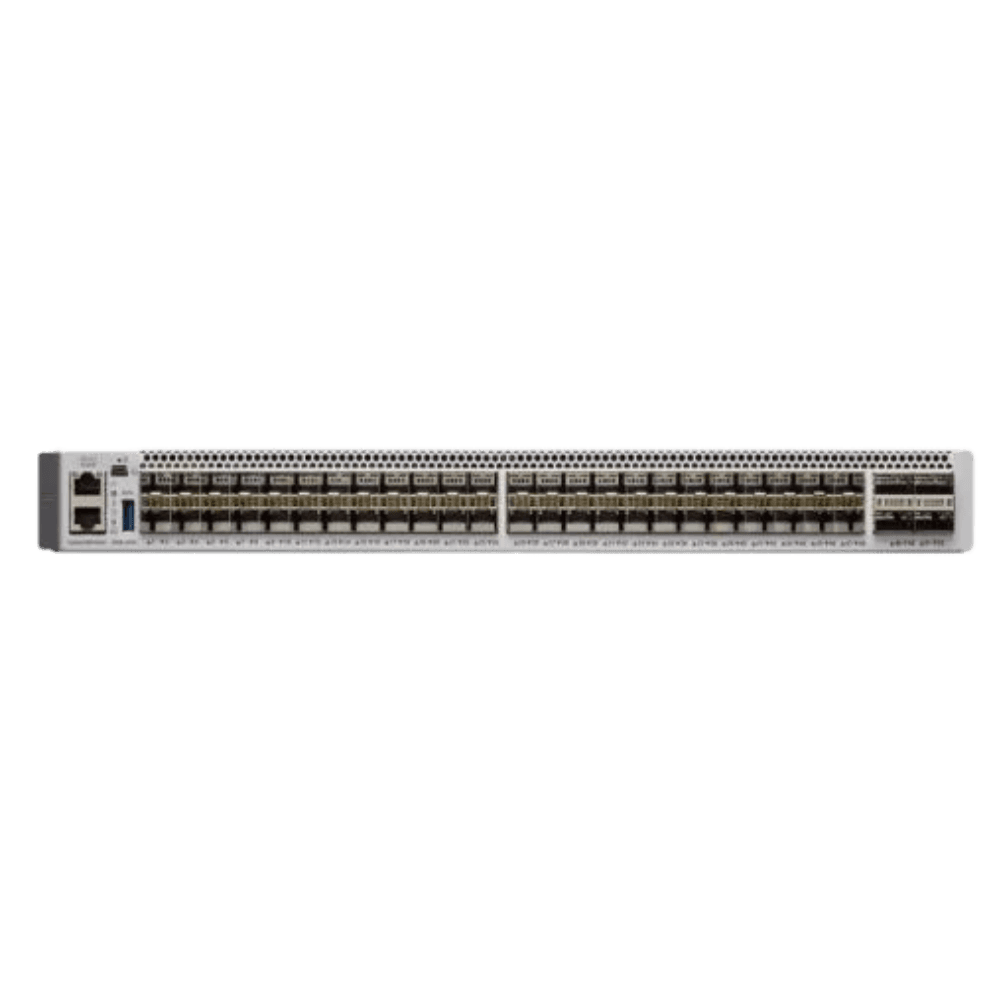
Cisco Catalyst C9500-48Y4C-A Switch | 48-Port 25G + 4-Port 100G | Network Advantage | Layer 3 Core Switch | With Single SMPS
Model Name : Cisco Catalyst C9500-48Y4C-A
Brand : Cisco
Key Features
Port Configuration: 48 × 25G SFP28 data ports + 4 × 100G QSFP28 uplinks.
Power Supply: Includes Single SMPS, providing efficient power delivery.
Software Image: Network Advantage for advanced Layer 3 routing and automation.
Switching Capacity: Up to 2.56 Tbps with 1.9 Bpps forwarding rate.
Stacking: Supports Cisco StackWise Virtual for high availability.
Security: MACsec-256 encryption, TrustSec, and policy-based segmentation.
Automation: Cisco DNA Center, NETCONF, and RESTCONF APIs supported.
Reliability: Redundant fans with front-to-back airflow for cooling efficiency.
Form Factor: 1U rack-mountable, energy-efficient design.
 1 Year Warranty
 Condition : Refurbished
Buy Product
- Description
- Specification
- Reviews
Cisco Catalyst C9500-48Y4C-A Switch is an advanced Layer 3 enterprise-class core and aggregation switch designed for high-speed, secure, and scalable campus networking.
Equipped with 48 × 25 Gigabit Ethernet (SFP28) data ports and 4 × 100 Gigabit Ethernet (QSFP28) uplink ports, this switch delivers exceptional throughput for demanding applications.
Running on the Network Advantage software image, it supports advanced routing, automation, and security capabilities such as Segment Routing, MPLS, MACsec encryption, and Cisco StackWise Virtual technology.
This model comes with a single SMPS (Switched Mode Power Supply), ensuring stable and efficient power delivery, ideal for enterprises seeking performance and reliability in a compact form factor.
Frequently Asked Questions For Cisco C9500-48Y4C-A
Q1. What is the port configuration of the Cisco C9500-48Y4C-A?
A: It features 48 × 25G SFP28 data ports and 4 × 100G QSFP28 uplinks, supporting high-speed campus aggregation.
Q2. What does “Single SMPS” mean?
A: “Single SMPS” refers to one internal Switched Mode Power Supply, offering efficient, stable power with minimal energy loss.
Q3. Does the C9500-48Y4C-A support stacking?
A: Yes, it supports Cisco StackWise Virtual, enabling two switches to act as a single logical device for high availability and redundancy.
Q4. What software license is included?
A: It comes with the Network Advantage image, supporting full Layer 3 routing, automation, and advanced security.
Q5. Can the power supply be upgraded or made redundant?
A: This model includes a single SMPS; a redundant PSU can be added if required for enhanced uptime.
Q6. Is this switch suitable for data center environments?
A: Yes, it is designed for enterprise core and aggregation layers, suitable for both campus backbones and data center top-of-rack deployments.
Similar Products


